KITES: You Can Count On Number Lines, 7 - 8
KITES: You Can Count On Number Lines, 7 - 8
Grade Levels
7th Grade, 8th Grade
Course, Subject
Related Academic Standards
Objectives
Students will:
Understand, represent and use numbers in a variety of equivalent forms (integer, fraction,
decimal, percent, exponential, and expanded notation).
Understand and apply ratios, proportions, and percents.
Develop an understanding of number theory (primes, factors, and multiples).
Recognize order relations for decimals, integers, and rational numbers.
Description
Students begin developing number sense by counting, recognizing, and ordering whole numbers. Students relate counting to grouping and place value. Numeration expands to understanding, ordering, and comparing fractions and decimals. Intermediate students represent and use numbers in a variety of forms (integers, fractions, decimals, percents, exponents, expanded and scientific notation). Students learn to apply ratios, proportions, and percents, and develop an understanding of rational and irrational numbers. Commencement-level students apply the properties of real numbers to various subsets of numbers and gain proficiency at recognizing the hierarchy of the complex number system.
The number line is an excellent tool for developing numerical understanding and making connections across number systems. Through the use of number lines, students can visually represent the relationships among whole numbers, integers, rational numbers, and irrational numbers. This representation gives each number a unique point on the line and a distance from zero depicting its magnitude and direction. Students use number lines to display operations, equivalents, and solutions.
Procedure
- Have students use a number line to locate and label positive and negative integers, rational numbers, irrational numbers, square roots, and numbers written in scientific notation.
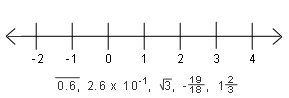
- Have students use a double number line to understand the relationship between the Fahrenheit and Celsius scales (see Activity Sheet 4).
- Have students use a number line to visually represent division of mixed numbers and fractions. If 4 divided by 2 means, "How many 2's are in 4," then 4 divided by 1/2 means, "How many halves are in 4" (see Activity Sheet 5).
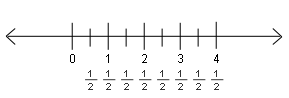
- Have students show the density property by finding numbers between any two given numbers. For example, a number between 3/5 and 4/5 could be 7/10 because 7/10 is between 6/10 and 8/10.
- Have students use a number line to find the midpoint of a line segment.
a. Find the midpoint of a line segment CD.
b. If P is an endpoint of a line segment and X is the midpoint, find the other endpoint.
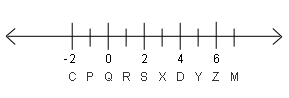
Source
Adapted from the NYS Department of Education Publication, A Toolkit for Mathematics Educators: Key Idea Tasks to Enhance Success (KITES).