Getting to Know the Collared Lizard
Getting to Know the Collared Lizard
Grade Levels
10th Grade, 11th Grade, 12th Grade, 7th Grade, 8th Grade, 9th Grade
Course, Subject
Environment and Ecology (Agriculture)
Organism Name
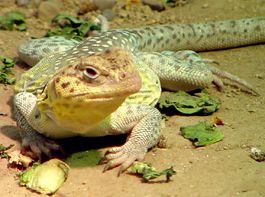
Common Name: Collared Lizard
Scientific Name: Crotaphytus collaris collaris
Classification Information

Kingdom: Animal
Phylum: Chordata
Class: Reptilia
Order: Squamata
Family: Iguanidae
Genus: Crotaphytus
Species: Collaris
Geographic Range and Habitat

As a Sonoran Desert species, the Collared Lizard can be found predominantly in Arizona, northern Mexico, and southeastern California.
The habitat can range from dry, rocky desert to hardwood forest.
Physical Characteristics
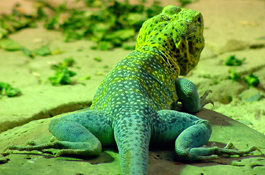
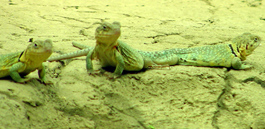
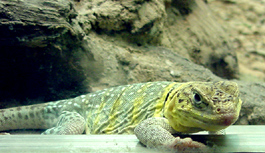
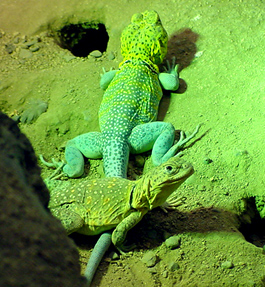
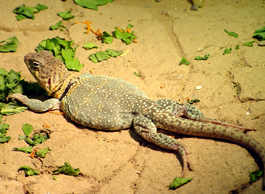
The Common Collared Lizard is a medium sized lizard of approximately 10 inches in length, males being larger than females. It is predominantly tan in color with variations of bright green, brown, olive, blue or yellow markings depending on the specific population. There are two black “collars” around the neck, giving the animal its name. Males are brighter in color than the females. However, during breeding season bright red or orange spots appear on the female indicating that she is pregnant.
Habits
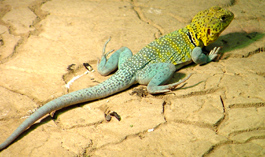
Collared lizards are excellent hunters with sharp vision. When prey is spotted, the lizard can sprint on its hind legs, raising the front of its body to a 45 angle. These lizards are diurnal, and can often be found basking on large rocks keeping an eye out for other individuals or food. Males are highly territorial and perform a display of head bobbing and push-ups when this territory is threatened. However, if threatened by a predator, the Common Collared Lizard will dart into rock crevices to avoid being eaten.
Diet
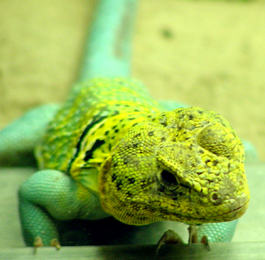
Collared lizards feed predominantly on grasshoppers, but will also eat other insects and lizards, including other collared lizards
Reproduction
Breeding takes place in early summer, but can occur more than once a year. The female lays between 1-13 eggs. Hatchlings emerge in late summer, early fall.
Natural History
No information located at this time.
Captive History
No information located at this time.
Conservation
Common Collard Lizards are not threatened or endangered at this time.
Did You Know?
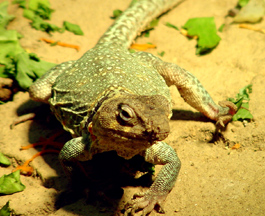
When hunting prey, the lizard becomes bipedal, running on its two back legs. Females develop bright red or orange spots when pregnant.
Author
Description
 As the third oldest zoo in the United States, the Buffalo Zoo houses some of the world's most exotic and endangered wildlife. In collaboration with the Center for Applied Technologies in Education, the Buffalo Zoo has provided these animal profiles to offer a glimpse into the diversity of the Zoo’s collection.