Getting to Know the Brazilian Agouti
Getting to Know the Brazilian Agouti
Grade Levels
3rd Grade, 4th Grade, 7th Grade, 8th Grade
Course, Subject
Related Academic Standards
Organism Name
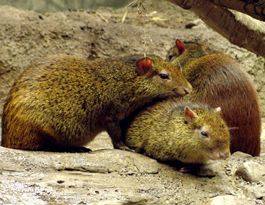
Common Name: Brazilian Agouti
Scientific Name: Dasyprocta leporina
Classification Information
Kingdom: Animal
Phylum: Chordata
Class: Mammalia
Order: Rodentia
Family: Dasyproctidae
Genus: Dasyprocta
Species: Leporina
Geographic Range and Habitat

As the name suggests, Brazilian Agouti’s range throughout Venezuela and eastern Brazil.
They are found throughout the forest, but tend towards areas with good undercover near rivers, streams and swamps.
Physical Characteristics

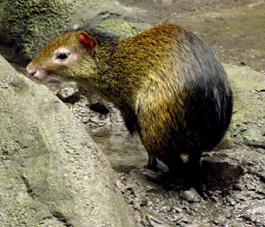
Agoutis are rabbit-sized rodents of approximately 16-25 inches in length, and 2-9 pounds in weight. They have slender limbs and course, rough, glossy hair that varies in color from red to dark brown. The ears are small; the tail is rudimentary.
Habits
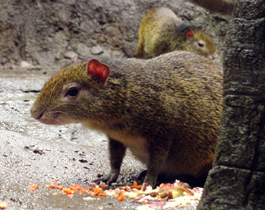
Agoutis are terrestrial and cursorial. They walk, trot and gallop on their toes. Their long back legs are used to propel them along, and they can jump over 6-feet into the air. This is very important since they have many large predators who hunt them for food including cats, dogs and humans. They are good swimmers. Agoutis possess an alarm call which is a series of low grunts and squeaks. They may also stamp their feet on the ground when alarmed.
Diet
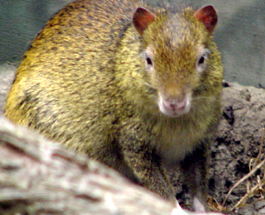
Agoutis are herbivores. They eat fallen fruits and nuts, leaves and roots.
Reproduction
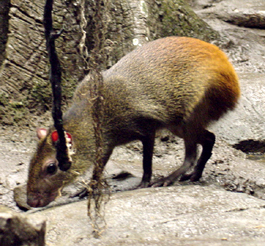
Sexual maturity is reached at about six months old. At this time, the adults, particularly the adult males, begin chasing them away to find a territory and mate of their own. Agoutis form monogamous pairs. The male has a habit of spraying the female with urine, causing her to gyrate and dance. After a few sprays and dances, she is ready to mate. Newborn Agouti are alert, well developed and fully furred. They can see, hear, and run around. As such, they are a target for many predators. The female will dig small individual holes for each of her young.
Natural History
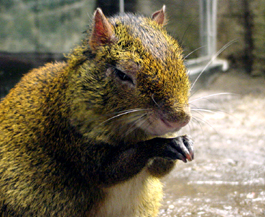
Man can thank the ready availability of the Brazil nut in a large part to the agouti. Brazil nuts are one of the agouti’s favorite fruits in the rainforest, especially since they are one of the very few animals that can break through the hard shell with their teeth. Brazil nut trees are native to the New World rainforest and cannot be cultivated on plantations. Since excess Brazil nuts are buried for safekeeping they have the opportunity to grow into additional trees to be cultivated for our use.
Captive History
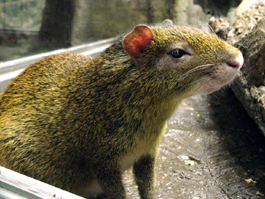
The record life span in captivity is 18 years.
Conservation
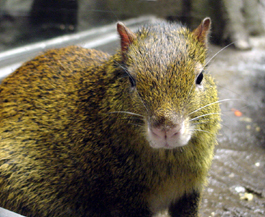
The agouti is abundant in the wild.
Did You Know?
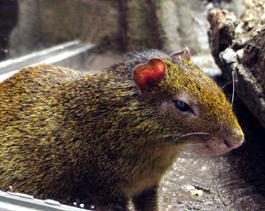
As a precursor to mating, the male sprays urine on the female, causing her to dance wildly.
Author
Description
 As the third oldest zoo in the United States, the Buffalo Zoo houses some of the world's most exotic and endangered wildlife. In collaboration with the Center for Applied Technologies in Education, the Buffalo Zoo has provided these animal profiles to offer a glimpse into the diversity of the Zoo’s collection.