Getting to Know the Bourke's Parrot
Getting to Know the Bourke's Parrot
Grade Levels
3rd Grade, 4th Grade, 7th Grade, 8th Grade
Course, Subject
Related Academic Standards
Organism Name
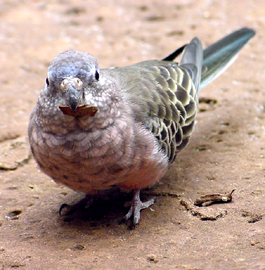
Common Name: Bourke's Parrot
Scientific Name: Neophema bourkii
Classification Information
Kingdom: Animal
Phylum: Chordata
Class: Aves
Order: Psittaciformes
Family: Psittacidae
Genus: Neophema
Species: Bourkii
Geographic Range and Habitat

Bourke’s Parrot is found in western-central Australia.
This parrot species can be found among the dense underbrush of an arid scrubland.
Physical Characteristics
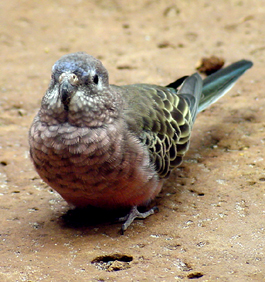
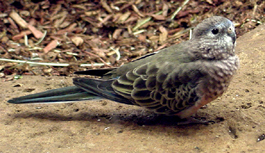
This is a small to medium parrot, about 9-12 inches tall. It is predominantly olive-brown in color with a pink breast and belly and blue markings on the shoulders. It has a long tail with blue markings underneath. There is also a line of blue above the eyes. This line is less evident in females who are also smaller and duller in color.
Habits
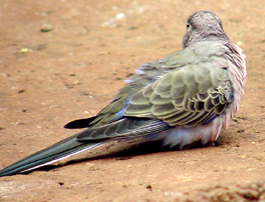
The Bourke’s Parrot is often called the “grass parrot” because it spends most of its time hidden and foraging in the underbrush. When startled it will fly swiftly into a nearby tree. They are rapid flyers with an audible “whirr” sound accompanying the wing-beats. Bourke’s Parrots roost and forage in small groups. Like many of the Australian Parrots, they drink water at dawn and predominantly at dusk-giving them the nick-name “night parrot.” Male Bourke’s Parrots perform a courtship display. They approach the female with their body erect, tails and wings slightly fanned. They then proceed to bob their heads and chatter to the female. This is followed by courtship feeding.
Diet
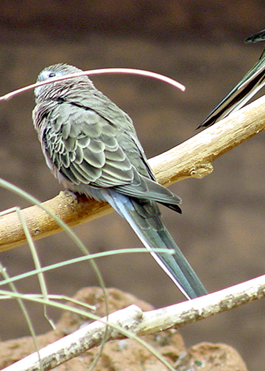
Diet consists mainly of grass seeds, but includes leaves and blossoms.
Reproduction
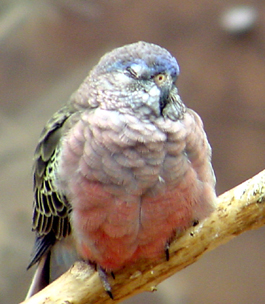
Sexual maturity is reached at one year. Breeding takes place from August to November and is preceded by the courtship display. A tree hollow close to the ground and lined with wood dust is the usual nesting site for the clutch of 3-6 eggs. The female Bourke’s Parrot incubates the eggs for approximately 18 days, during which the male feeds her and tends to her needs.
Natural History
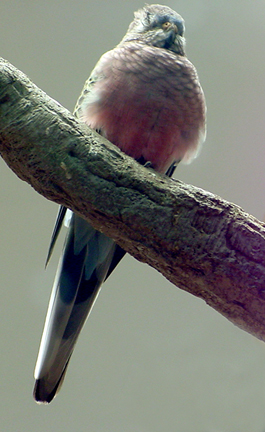
At the end of the 1930’s this parrot was believed to be extinct. Widespread sheep grazing had significantly reduced the food supply and foraging areas of the Bourke’s Parrot. A drought in Western Australia between 1937-1940 brought the sheep flocks down to 10% of their original numbers. The natural vegetation recovered, allowing the Bourke’s Parrot to survive.
Captive History
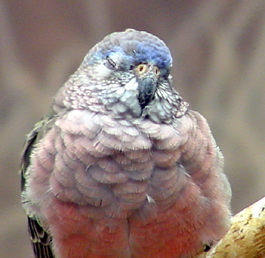
Bourke’s Parrots do very well in captivity. They are popular with bird enthusiasts because they are pleasant little birds who breed easily under human care.
Conservation
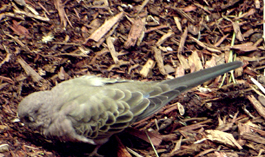
They are now common.
Did You Know?
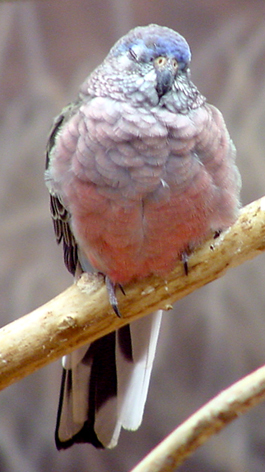
Bourke’s Parrots are now the most common parrot in certain areas of Southwest Australia, particularly areas with well-established thorn-acacias.
Author
Description
 As the third oldest zoo in the United States, the Buffalo Zoo houses some of the world's most exotic and endangered wildlife. In collaboration with the Center for Applied Technologies in Education, the Buffalo Zoo has provided these animal profiles to offer a glimpse into the diversity of the Zoo’s collection.